D: It’s time for a brand new featured artist interview!
This time around, we’re interviewing Danielle Draik. Danielle, would you please take a moment to introduce yourself to our readers? Who are you, where are you based, what’s your medium of choice, and how long have you been active as an artist?
DD: Hello! My name is Danielle Draik and I am @artofddraik on most social media platforms. I’m a fine art multimedia artist who focuses on the paranormal, occult, and unknown/esoteric phenomena. I’m an American with Polish/German/Irish ancestry and I was born and raised in Queens, New York where I am currently still operating from. I hold my BFA in Fine Arts from SUNY FIT and I have been an artist in residence at Mildred’s Lane in Narrowsburg, NY and Soaring Gardens in Laceyville, PA. I’ve been both creative and interested in the paranormal since I was a small child, but I didn’t start exhibiting seriously until about 2013. My professional work’s subject matter has always leaned more towards the non-physical, generally focusing on spiritual condition and the metaphysical.
Being a “multimedia” artist, I work in a wide variety of mediums and methods of “making”: I’ve done public sculpture, small sculpture, relief printing, paintings, collage, illustration and comics, zines, writing, and installation work. Funnily enough, I had a supremely hard time picking up collage for years and joked to myself that I would probably focus on collage seriously one day. Now, its one of the mediums I’m mainly working in, in tandem with a series of sculptures. I use a lot of materials that change under certain conditions, generally light, position, and heat. I like this ephemeral quality to my material. It makes a stagnant thing more than just an object. It gives it something to commune with, something with action and history. Right now my current focus with this is fleshing out an archetypal/universal language that I will continue to use in my practice and the concept of communing with non-human intelligences. I’m going to reintegrate painting more into my practice in 2026. I promise.
D: Wow, you’ve explored a ton of different artistic media already. It’s interesting to hear how your relation with collage changed over time. Was there anything specific that triggered that shift, or was it just something that happened over time?
DD: It kind of happened over time. I was always futzing around with textures, photographing things, and hoarding digital media for reference. I’ve made a handful of sculptural costumes and I’ve staged a lot of photoshoots to document these, but to be honest a lot of these older photos kind of fall flat. I’m also not committed to being a set designer right now, or building up landscapes or settings in the way I think I work with my pieces. Who is going to pay for that and store all that shit anyway? Having a massive library of images and beginning to collage my photos of these sculptural figures really drove home the otherworldly element. Suddenly, the weird light pattern on my office’s floor became the backdrop to an alien abduction scenario. A gaudy living room can be the perfect setting for a lavishly posed demonic entity. Collage has given me time to work with spaces that aren’t available to me to stage in a traditional sense. I can take a photo of an ephemeral moment and be in and out of a space on my own terms and converse with it on my own time. They become dreamy. I can play with and visualize scale in a way I wouldn’t really be able to do otherwise. I use drawing in my collages a lot, too. It’s a very free medium for me and combines a lot of my other practices.
D: The way the medium lets you get away with messing about in pretty much any way you want is one of those things I love most about collage (though I guess it can be type of self-imposed hell for those who are prone to option paralysis…). I really can’t think of all too many other media that allow for such a degree of creative expression.
Considering the fact that you’re a multimedia artist, how do you decide which medium best lets you express the ideas in your head when you start a new project?
DD: Artmaking with a multimedia mindset is a good practice in abstract problem solving. You have to hedge your bets on where your skillset lies, how you can improve, and how you can try to show up to your ideas. How do you want something to be seen/displayed/consumed? What do you have access to? How do you want to work as a self serving practice? “The Work” is work but ultimately it should be fun. And enlightening.
I also don’t mind viewing things as failures or things that need to be reworked. I can and will remake the same piece a few times in different ways if I think I can do it better down the line and it’s worth revisiting. That type of internal freedom allows for more opportunities for creative exploration.
D: How do you decide when an abandoned piece is worth revisiting and when it’s better off remaining abandoned?
DD: When you’re beating a dead horse, put the piece aside. You will be a different person tomorrow, in six months, in a year, in ten. Your ideas and methods will change. However, sometimes you just know when something is wrong and is no longer worth attempting to develop.
This is also a good time to get more people in your studio. I have friends that go to crit groups. I would put fraught pieces in an area of my studio so that I could eventually bring them to my car and dump them in the woods for people to adopt. When guests came to visit, they would share their opinions, which would sometimes save a piece from the chopping block. One of my favorite older pieces had this fate. People who know your work, who are outside of you, can offer up a decent perspective (of which you are allowed to agree or disagree). And there’s always more art to make.

D: Out of curiosity, what’s the longest you’ve gone between starting a piece, putting it aside, and eventually revisiting it?
DD: I think the longest one that I have truly put to bed was 4-5 years. I have one that I started 11 years ago that I want to revisit. It lives in storage that is not-in-my-studio at the current moment. I’ll be real, one of the main reasons I haven’t gotten back to it is because I mounted it like shit: It’s a 3 foot by 3 foot mirror with industrial grade caulk on OSB and, like, 30 pounds. I’m still really into the concept behind the piece, even more so now than back then, so I would really like to get back to it. I paint completely different now too and I actually put it aside because I wasn’t really feeling the way I was painting it. It’ll be weird trying to see how I can bring out how I render now compared to back then. Good exercise. We’ll see where it goes, when it goes.
D: Since we were on the topic of artistic media earlier anyway, is there any medium you haven’t worked in (or at least not that much) that you’d like to explore further if you were given the opportunity/resources?
DD: I have always wanted to attempt glasswork, specifically neon bending. I would love to try my hand at that, but the overheads are fairly high and I can only begin to fathom what a studio set up for that kind of medium looks like outside of a dedicated facility. Thankfully, NYC has a few glass studios, so I would like to try my hand at it one day. I really dig alternative/designer lighting.
D: You mentioned you like using materials that change under specific conditions. A few years back, we featured some of your work in our group exhibition IMPRINT. Those pieces were thermochromic prints. How’d you get into that type of printmaking?
DD: I am really into messing around with non-traditional materials, figuring out their makeup of longevity, what they look like over time, and how I can push them. Thermochromic material is really interesting. It has the ability to move and shift dynamically before your eyes. There’s two types, as far as I’m aware: reversible and non-reversible.
Reversible pigments being those you see in those “hypercolor” t-shirts from the 90s or a novelty mug that changes color when you put hot fluid in it. You can buy these pigments from suppliers and do what thou wilt. They will go back and forth expressing certain qualities (usually clear to a solid color like black) until they stop working.
An example of non-reversible material is receipt paper where the pigment hits heat and then sits in a coated matrix until it stops expressing and eventually fades.
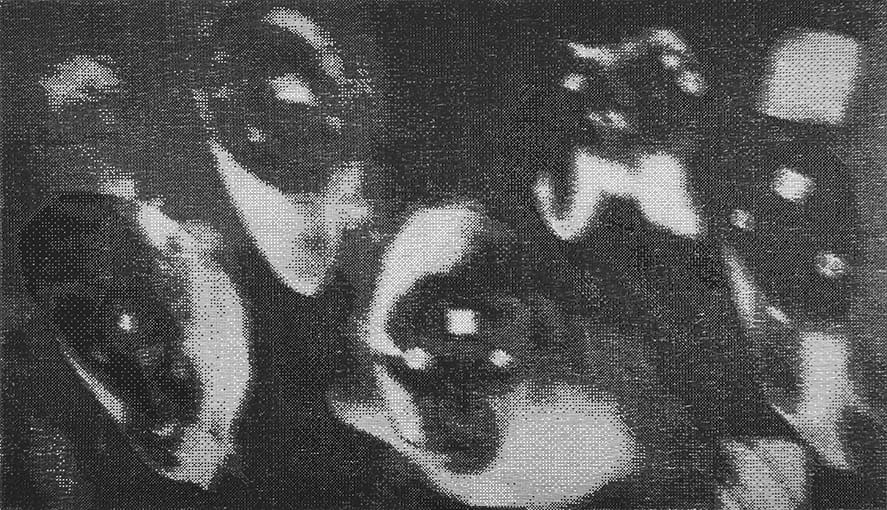
In both of these instances, the pigments are extremely volatile and subject to degradation fairly quick, so archivality is an issue. They are not lightfast, losing their effects within a short timeframe. So, when making my collages with thermochromic materials, I assemble and then go through a long process of photographing them throughout their transition. I usually have 30-50 photos of a single collage as I work with it and as it changes before my eyes. After I get what I think I want, I’ll print THAT and photograph it for archival purposes. I still have the original collages stored archivally away from the elements, but even with all that babying, they look very different from the images I took when they were finished.
The two collages I sent to IMPRINT were archival c-prints of these final thermochromic images, so THOSE will never shift or change and they are what I consider to be the “final image”. “Astral Projection and the Energy Grid” and “The Clickout” (the two pieces that were in IMPRINT) are both pieces based on a method of meditation that some people, when skilled enough, claim to have the ability to come into contact and commune with NHI. Very fun.
I think the transience of the material matches the overarching concept of a transient state, which is kind of what non-corporeal shenanigans are all about, right?

D: What an incredibly wild medium.
This is one of those certified Semioculus interview classics: what’s been your proudest achievement as an artist so far?
DD: I am very proud of my work, where I’ve come, and what I’ve done. Although I’m not satisfied (and I don’t think I will ever be satisfied), I’ve managed to find myself professionally exploring a topic that is a deep facet of my being and push myself and my brain to think in so many different ways. People will see my work and reach out to me to tell me their “weird” stories, so much so that I had to add a separate contact form on my website. It happens all the time. It’s an honor to be trusted with something like that. I am in a place where I am eager to learn and create more. That’s a gift. I need to do more.
D: That’s honestly pretty incredible. Are those submitted stories something you simply treasure as a form of connection between you and your audience, or do you also actively use them in your practice?
DD: I do use elements of recurring phenomena in my practice to kind of nail down and branch off of archetypes and formulate an expanding visual language. The concept of creating a rubric that delivers a message that can span time and culture is not new, but it’s a concept I’m throwing my hat into. It’s an overarching concept I’ve had in my work since I really began focusing on a practice was motifs that I had always leaned on and the dissection of those. Why do I automatically envision “xyz”? Why do I lean towards “this or that”. What happens when someone sees differently? There’s also the idea that NHI encounters follow common threads/archetypes in relation to the culture the experiencer is used to and that their “true form” isn’t something we’re privy to/can conceive of. So the visual descriptors that people use are pretty important to me in stories. I would like to compile them in a better archive rather than just a haphazard file on my computer or in a notebook. I have a lot of notes that need to be digitized too. I have a few ideas for side projects regarding these stories, but those ingredients haven’t even reached the burner yet and consent with this information is really important to me – so I’m keeping these ideas under wraps for now.
D: I’m always pretty curious about how the artists we get to interview ended up stumbling onto the path of the dark and surreal. You said you’ve been interested in the paranormal ever since you were a kid. What started you off on that path?
DD: I usually call it “growing up in a paranormally-inclined family”. There’s a side of my family that all have “gifts”/”inclinations” and we can at least trace it back to when that side came to America. However, everyone in my immediate blood relation has dealt with unexplained phenomena and have utilized some sort of folk magic practices in response to it. It was just something I grew up with and was treated as something normal and not disregarded. I’m sure some readers are not going to jive with the “woo”, so please understand that there is a cultural element that I bring to my work too. Coastal American Christian-appropriated ‘witchery’ is a mish-mash and unique flavor which I love exploring and talking about. It’s a chaotic and living practice.
I recently did a visual essay for Paroxysm Horror Anthology (volume 5) based on a joint experience that my family and I had called, “On How to Avoid Becoming a Ghost” which had me dissecting a lot of family history, trauma, and poring over scientific articles published from the Division of Perceptual Studies at the University of Virginia to try and get some insight on what it is we experienced.
A creative path, in conjunction with research and scientific/evidence based exploration, is a holistic way to approach the paranormal. It doesn’t confine me to a methodology unless I want/need to and it also allows me to explore my own situations. The topic is so broad and multifaceted anyway, to not attack it from multiple angles seems short-sighted.

D: That particular Coastal American brand of witchery is an area I can’t say I’m too familiar with myself, so, at the risk of scaring off the people in the audience who don’t gel with the esoteric, could you give me some further context? Have you drawn on these personal connections to the paranormal in any of your other work?
DD: I preface that I don’t consider myself religious but, to sum up the flavor I grew up with: “Coastal American Christian-appropriated witchery” is what I would describe as the last 30/40 years of a blend of folk religion (or honestly, whatever deviation of dogma from the belief system you adhere to), recognition and growth of the ‘neopagan’ movement in America, mixed in with the beliefs and cultural practices of the people you work with in your community.
The NE coastal region I grew up in is Catholic/Protestant/Judaism heavy, primarily due to an influx of WW2/Post-War immigration. Of course, coastal cities are high-density and diverse, so you get a lot of push and pull between establishing and holding onto your culture-of-origin and assimilation. Folk Catholicism or Cultural Catholicism primarily what I’m referring to, which boiled down is this personal and cultural/ethnic specific practice that works alongside a larger dogmatic belief system. Folk Catholicism includes saint veneration, which has appealed to practitioners who otherwise feel unsafe practicing polytheistic belief systems or adhere to a lifestyle that isn’t generally in line with the structure that the “traditional church” desires. It has become popular for people who believe they have lost their sense of hope and agency, which is very clearly a growing sentiment in this country. Veneration of Santa Muerte has grown significantly in popularity, even outside of Mexican tradition, since COVID and the violence against the Latin population in America. The desire to gain power and insight during powerless times is part of the human condition.
The new age movement coming off the heels of the height of the Satanic Panic, coupled with the rise of the internet, brought an accessible lens onto a wide variety of esoteric practices which was a giant leap in the growth of the American ‘neopaganism’ movement. Interacting with practitioners across the world via chat boards and web 1.0 websites was instantaneous instead of having to join a snail-mail newsletter or subscribe to a zine. Going into a corporate bookstore and picking up The Solitary Witch (a controversial book in its community, and my mentioning of it is not an endorsement, but a nod) or The Satanic Bible was kind of like a rite of passage for a dorky alternative child. It was familiar and revolutionary at the same time. Was this method of entering the occult very sensationalist and easily palpable? Absolutely. But it has left its cultural mark on the people who have grown up to take their practices seriously today.
It’s also where you live. In terms of magic practice, I live in a brujeria-rich area, so if I’m picking up anything I am going to my local botanica to see if they have what I need and those are my practicing neighbors I talk to. I learned about the Polish fighting alongside the Haitians during the Haitian Revolution at an occult store, not realizing that iconography I grew up with in my home (that has its own “miraculous” associated folklore in Poland) had been integrated into Haitian Voudou.
Has this come up in my work? Beliefs and systems of living have their way of sneaking themselves into your practice. I incorporate mirrors and reflective surfaces into my practice with the idea that they are magickal objects. I have an ongoing series of paintings on “folk” saints that are emblematic of complex states of consciousness. Nothing extremely derivative, but there’s definitely “wherever you go, there you are” type shit.
D: Thanks for breaking that down! I guess it’s almost impossible for artists not to draw from their belief systems in some form when shaping their creative practice.

You touched on how the rise of the internet has made knowledge of esoteric practices more accessible. I’m not sure if I’m about to unleash some type of hot-take-related hell with this one, but would you say that this increased accessibility has been more of a boon or a bane overall?
DD: I’d file it under ‘chaotic neutral’ at this given moment. I am very much in support of knowledge being for the people, breaking down barriers that gatekeep information, and for making that media last for as long as we can. The internet today is different from the internet of even a year ago. The way people are interacting with “esoteric practices” is concerning but not for accessibility’s sake. Esotericism, by definition, is an amalgam subject. You have to take into account a lot of human history and its inner workings. A lot of the information you seek isn’t easily palpable. In order to really get a good understanding of esoteric practices, you still have to put in a significant amount of mental overhead.
People have always picked and chose what beliefs have worked for them, and that will always continue. Any ire I have about the change of our digital landscape is due to the fact that our global information and social space has been corporatized and turned into an intentionally depressogenic environment. If I were to hazard any guesses, I’d say that there’s more of a chance for more fringe ideas and communities to emerge as we ride deeper into a “post-truth society”. Vulnerable people are susceptible to magical thinking, escapism, and delusion. The concept of who is “at-risk” will continue to broaden as resources continue to break down/shift (quality of digital information) and physical needs are hoarded.
The Demon Haunted World: Science as a Candle in the Dark was published in 1995, but has become increasingly relevant. Conscious critical thought is at risk and I hope that anyone approaching esotericism in the current age does so with an overclocking bullshit meter. I am curious to see what type of beliefs evolve forward, but I’m not going to say I’m looking forward to it.
D: I was one of those kids who grew up right along with the internet, and it’s honestly depressing to see how much the digital landscape has changed since the dawn of the smartphone era. Don’t want to go all ‘millenial yelling at cloud’ here, but it definitely feels like the overall quality of information and the availability of resources has taken a total nosedive since we entered the AI slop era. Do you think there’s any way out of the hole?
DD: We can yell at cloud: what a fucking nosedive. I guess the buildup has been going on for a while, but damn. The surface web landscape has been getting progressively shittier pre-AI due to aforementioned rampant corporatism, but the schism between – I don’t know, lets call it pre-slop and post-slop internet – is staggering. I also think as our global landscape gets more precarious and real life continues to integrate more data-scraping/mass-surveillance (which is what AI ultimately is), our internet will follow suit, further developing into being a nuisance rather than a helpful tool or a space to explore.
I don’t know if there’s going to be a way “out of the hole”, but I believe when even the mundane aspects of the internet become too much of a drain to interact with, users will reject a large percentage of the internet as we know it today. This doesn’t mean I’m saying we will all collectively log off and touch grass (right now society is far too integrated with webspace), but I do think there will be a change in the way the People conceptualize and navigate tech. I think people will place more importance on things they can rely on when the digital space does not serve them any longer. It doesn’t take an academic or moral standpoint against AI to understand when something is too much of a hassle to use, we move away from it. Maybe this means there will be a boom of digital microspaces that people can conglomerate to or “disconnected” tech will have more of a resurgence than it is now.
What this means for the capitalist class, I’m not certain. I cannot predict how large the bubble of AI will get, what chaotic things could happen both online and offline, and how much of a net negative it will have on the quality of life for all of us.
D: God, I do wish some kind of collective grass-touching movement could get off the ground, but I think we’re too locked into the digital world to ever go back at this point.
Anyway, I veered a bit off-topic there. As you mentioned earlier, the paranormal is an incredibly broad and multifaceted topic, covering everything from extraterrestrial phenomena to occult rituals. Are there any areas beyond the ones you have a direct connection to that interest you in particular?
DD: I have a growing interest in divination, especially since, historically, humans have always tried to gain insight into things they don’t understand. It’s one of the first practices of the scientific method (testing out a theory, applying practice, seeing an outcome, etc) and in a broader application, a unique type of cultural examination. So there’s that argument that predictive science is a method of divination. Many aspects of contemporary divination (cards, pendulums, tea leaves, etc,) are community oriented and act therapeutically. Sociologically, it’s really interesting. My divining skills are high key shit though, so I’m not sure if much artistic application is in my future.
D: I feel like some people would argue that even the mere act of creating art in and of itself could count as a form of divination. I’m not qualified to say anything about whether they’re right or not, but they do both heavily involve systems of symbolic language.

Now, aside from your interest in the paranormal, what (or perhaps who) has influenced your overall artistic worldview the most?
DD: Spite.
D: Spite? In what sense?
DD: Spite is a fantastic motivator. There are a myriad of things that get in the way of a creative person doing a creative thing. Doing something as transcendent as making artwork in the face of yourself, doubt, rejection, limitations, etc is a solid “fuck you”. It is very important to get praise for your work, but there is something self-actualizing by doing something so personal in spite of how other people feel about it.
D: It’s very difficult to detach yourself from how others perceive your work, though, isn’t it? Especially given how much of an artist’s work involves maintaining a social media brand alongside their primary practice. How do you do it?
DD: Through gritted teeth. Right now, I’m pretty much just on Instagram and Bluesky. My social media posting voice is incredibly sanitized so I don’t get hit with any shadowbans or surprise takedowns. One of my 2026 art chores is to make a mailing list, which I think would safeguard me in case of more meta-related fuckery or the dissolving of platforms. I want to make a newsletter/blog (akin to substack or medium) and I’m thinking of hosting it myself on my website or something like neocities.
Do I screw myself by not doing a lot of pointed “content output”? Probably. I’ll have to pick it up when I release bigger projects in the future. I’ve done it before. Having a public voice is important, but right now it’s exhausting, especially when visibility metrics keep switching up. I’d rather avoid shifting goalposts. Please send an assistant, or the will to shill.
D: It’s hell out there right now. I know I’m slipping back into the ‘millennial yelling at digital cloud’ thing from before, but I’m really not a fan of how artists are essentially forced into short form video content/dancing-bear shit just for the CHANCE of possibly being seen by more than ten people. Grim, that’s all I have to say. I’ve spoken to other people about this in the past, and some of them have said it’s probably best to just go full grassroots and focus on whatever is going on in your local scene. How do you feel about that?
DD: I can totally see that. I’m not very happy about it. I’ve never liked feeling limited with my reach and have always been someone who loves to travel and ship out in order to show my work. NYC is so in flux all of the time, so I still feel it is incredibly valuable to keep my showing range broad.
D: Last summer, you did a residency at Soaring Gardens where you worked on a series of mixed media collage/drawings and another series of ink/gouache drawings. Would you please share something about the experience and the projects you worked on?
DD: Soaring Gardens is a fully funded, self directed artist residency in the North Eastern region of Pennsylvania. I was there for three weeks.
As you mentioned, I worked on two series during my stay, which were both explorations of certain numbers and symbols I’m using in my work.
12 Close Encounters is a series of twelve ink and gouache drawings based off of Experiencer depictions/descriptions (some historical, some personally submitted to me, some from my library, etc.). They are mostly of craft/ship experiences as those are generally pretty simple shapes, and the numbers of “lights” and sides of the craft coincide with the sort of authoritative/proselytizing text on the bottoms. The intent was to make them reminiscent of wild and frantic scrawlings. I have been aiming to work out a numerical rubric for my work, and this was one of the first times I was able to really face that head-on for an extended period of time. I have a ton of notes now from this series. They are all 24 x 36 inches.
Examinations of Psychoactivity is a series of 5 thermochromic collages/drawings experimenting with how I should depict psychic/energetic activity in further work. This is kind of in the same wheelhouse of “methods of meditation allow me to talk to entities”, but that’s not the goal in this body of work. This series focuses on the practitioner rather than the encounter. Figuring out the importance/”weight” of more complex shapes and fluid lines was the goal here. They are reminiscent of a training module. Since they’re thermochromic, I would love to get 18 x 24 inch (the size of the original collages) archival prints of them done now that they’re photographed.
Soaring Gardens was an absolutely wonderful experience and not only did I get to tackle work I had been wanting to focus on for years, I was able to integrate myself into a new environment with the most important aspect of myself (my work) at the forefront.
D: Very glad to hear it was such a productive experience overall!

Do you have any bigger projects in store for 2026? Anything new in the works you’d be willing to drop some early spoilers/teasers for?
DD: Yes! I will be attending a residency with the Constance Saltonstall Foundation for the Arts later this year. Saltonstall is a multidisciplinary residency in Ithaca, NY. While there, I plan to focus on stories based on sightings/encounters in Tompkins County (where the residency is located) and specifically integrate them into my visual vocabulary with collages. Upstate NY is a bit of a hotspot for UFO/UAP phenomena. Before I attend, I will be seeking interviews with residents and local historians to collect data before I make work. This is the first time I am able to really “be on the scene” so to speak and I am elated. I just hope some people want to talk to me.
D: That sounds cool. Hope it’ll go well!
By the way, what’s the dark/surreal art scene like where you live? Any collectives, spaces, or specific artists that would appeal to those who’re into our particular brand of weirdness? Are there any places you’d recommend outside of the art world?
DD: The subject of dark art is more en vogue right now (so hot rn), but the spaces are very much in flux. I’ve seen a ton of great shows recently, but the spaces where they were held aren’t committed to “dark art”. We had a handful of tattoo/art galleries that have either fully moved to tattooing or have shuttered and just do online exhibitions. Many galleries here come and go within a handful of months. Our largest metal bar that would also host events, St. Vitus, closed in 2024 (but operates as a booking organizer for bands at surrounding venues). Our more outfitted occult bookstore and event space, Catland, closed in 2023. Of course, this means there are a ton of smaller/DIY set ups that are trying to get their footing right now, but nothing with a solid geographical stronghold. The rent is too damn high.
Pop-ups, new markets, and new conventions are a bigger thing right now, so time will tell if something becomes more of a mainstay. Quimbys NYC (Quimby’s Chicago predates NYC, but both carry zines) is a blessing to the zines/self publishing community. Quimby’s also holds/promotes events either in store or at surrounding venues in the area. The Twisted Spine, a very comprehensive horror bookstore and cafe, just opened up recently.
There are more out-of-state/out of city opportunities that I find myself going to, which I don’t mind. New Jersey and Pennsylvania are two states close to NYC that have a more sustained Dark Art community with many different punk markets and events.
Outside of the art world proper, we have an amazing food culture and sometimes I half-heartedly joke that it’s the only thing keeping me here. There’s a light calculation that it would take around 23 years to eat at every restaurant in NYC if you’re ordering one meal a day. Kalustyan’s, an import grocer in Manhattan, is probably one of my favorite places to go that isn’t an art store. Mostly an ingredient shop, they have consumables from all around the world, packaged with history and information of the product. It is almost like a library. A lot of my friends come to NYC and ask me what to do, and I take them around to where they want to go, but have to inform them that they’re also here to eat.
This interview is happening in 2026, so I have my fingers crossed that someone reads this and messages me and tells me I should have mentioned something rad.
D: That whole ‘dark art scene is there, but the venues aren’t’ thing seems to be frustratingly common all over the place.

There’s one more thing I’d like to touch on: zines! So, you’ve released a fair share of art zines of your own in the past. What first got you into the world of zines?
DD: After I left school, I started selling my artwork at fares and conventions with some of my illustration/comics leaning friends. I was the odd man out with a few standalone prints of paintings and some small sculptures, but it put me in the environment of other creative folk who properly introduced me to art zines. I had known about micro-presses from the goth/metal/occult scenes online, but the wires didn’t cross for me that my own work mattered in this fashion until I got to talking to people who encouraged me to “just make a fucking zine”. We need to all just make a fucking zine. My first zine was a collection of drawings I was doing of a series of sculptures I was making (for a show that didn’t even end up happening). The zine ended up being really popular. It snowballed from there.
D: It seems to have snowballed quite hard! One of the zines you’ve released in recent years was To Be Seen, a collaborative work created together with Max Fletcher. For this one, your contribution to the project was mainly on the writing side rather than the visual. Was that a new experience for you or are these longer written projects something you’ve experimented with before?
DD: To Be Seen was a lot of fun and I love getting to stretch my legs with my writing. For those who aren’t familiar, To Be Seen is a 44 page comic illustrated by my longtime friend, Max Fletcher and written by me. It follows two young women who are paranormal investigators, one being a generational witch and one being a local historian, and their somewhat hubristic encounter with something akin to a Tulpa. It’s pretty heavy handed with themes of mental illness.
TBS started, as many projects do, with one half of the team saying, “Do you want to do a comic lol” with the response of “lol yeah sure.” TBS was made as a one-shot, but I’m writing a follow up to it with Max illustrating it again. There’s no set timeline for us working on this, so right now it is in the percolating stage. I would, eventually, like all the stories we do with these characters to be printed together. I’ve also done a few linocuts for the story, and I’d like to ask a few friends to do some splash work for it too. Low stakes (no deadline), high reward (fun).
I was writing long before I was taking visual art seriously and I’ve always been fantasy/horror oriented. Even though I work in the capital “F” Fine Arts, my work has always been fairly narrative. World building is a helpful tool in artwork regardless of what the craft is.
D: It’d be neat if you could work things out to the point where you’d end up with a short story collection (short comic collection?) focused on those characters. Hopefully you’ll manage to realize that eventually!
Is there any zine you’ve worked on that stands out as a personal favorite?
DD: I think my zine, SPEAK UP, is my current favorite. SPEAK UP is a non-fiction, first person account of an instance of astral projection and the attempt of receiving a message in that type of noncorporeal state. The speaker encounters what seems to be a sentinel-type being and an altercation occurs.
It’s text and thermo-collage, and through a grant I was able to get my friend Heimir Snær @heimir.snaer to risograph print and assemble them for me in Reykjavík. Copies are printed in a narrow-vertical format (6 x 3.5 inches), on a really nice weighted and toothy paper, and I think the thermo-collages look absolutely stellar when riso printed. It’s one of the few times where the actual artwork came out exactly how I envisioned it in my head.
D: We’ve just about reached the end of this interview. Thank you once again for being willing to share some of your thoughts with us!
As always, I’d like to wrap things up with our usual ‘shout out’ segment. Basically, this is the time and place to gush about the life-changing novel you’ve recently read, that album you discovered, and so on… Or, alternatively, you can just plug some other artists you like! Go crazy.
DD: As of late musically, I’ve been really into Ak’chamel and was lucky enough to see them a few months back. Poison Ruin just dropped a new album which is a little bit different then their older stuff, which I’m a big fan of, and it is a very good listen. In terms of research, I just started the Seneca Lakes Mysteries podcast which was recommended to me since I am headed up that way for Saltonstall and I’m also reading A Separate Reality, Further Conversations with Don Juan by Carlos Castaneda. I’ll be taking a day to go see the Leonor Fini exhibit in Manhattan soon, as it has just opened and I love her work. I saw a massive retrospective of her life and work a few years ago at the Museum of Sex and it was one of the more inspiring shows I have been to. I’m excited to get the chance to revisit her paintings.